
Review
Stickman Hook Review: Simple Swinging, Surprisingly Addictive Some games win you over with spectacle. Stickman Hook does it with momen...


Stickman Hook Review: A Simple Swing Game That Keeps You Coming Back
Stickman Hook Review: Simple Swinging, Surprisingly Addictive
Some games win you over with spectacle. Stickman Hook does it with momentum. At first glance, it looks like the kind of free browser-friendly time waster you tap open for a minute and forget about. Then a few stages later, you realize you’ve been saying “one more run” for twenty minutes. As an experienced gamer, I’ll say this right away: Stickman Hook knows exactly what it is. It does not pretend to be deeper than it is, and that honesty is part of its charm.
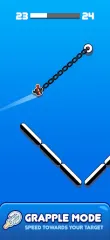
The core loop is almost absurdly clean. You play as a stickman, latch onto hooks, swing through short obstacle courses, and try to land cleanly at the finish. That is the full pitch, yet it works because the controls are so immediate. You can download it quickly, install it in seconds on supported devices, and start playing without a long tutorial or a wall of menus. It’s the kind of game that respects your time, which matters more than people admit.
First Impressions: Instant Flow, No Filler
What stands out first is the pace. Levels are short, restarts are instant, and the game encourages experimentation without punishing curiosity too harshly. If you miss a hook, you’re already back in again. That tight retry loop is the real design strength here. It gives Stickman Hook an arcade feel even though it lives mostly in the mobile and browser space.
The presentation is minimal, but not lazy. Animated movement is smooth, and the stickman physics are expressive enough to make every swing feel readable. You don’t need a complex HUD or layers of systems. You need timing, rhythm, and a little nerve. The result is a game that feels easy to pick up, but not mindless. Getting through later stages cleanly takes more awareness than it first appears.
Gameplay Loop: Timing Over Complexity
There’s real satisfaction in the swing itself. You attach, arc forward, release, and chain momentum into the next hook. That rhythm is the whole game, and it’s surprisingly easy to get absorbed by it. The best runs feel like a dance you’ve learned through repetition rather than instruction.
What makes this loop work is how forgiving it can be while still demanding precision. You’re not juggling inventories or character builds. You’re reading spacing, angle, and velocity. When a mistake happens, it feels fair. That fairness matters a lot in a game built on repetition. I’ve played plenty of action games that overstay their welcome with cheap failures. Stickman Hook avoids that trap by keeping the course compact and the reset fast.
The game also benefits from a strong sense of progression, even if that progression is mostly structural. New layouts gradually ask for better timing, cleaner commitment, and a steadier sense of momentum. It never becomes a grand challenge in the traditional sense, but it does become more demanding in a way that keeps the loop fresh longer than expected.
Controls and Feel Across Platforms
On touch devices, the game feels especially natural. A single input is all you need, and that makes the difference between a charming diversion and a frustrating one. On larger screens, whether you’re on browser or a supported device, the simplicity still holds up. I liked that the game never tries to overcomplicate movement just because it can.
Since many players look for unblocked access during breaks or in restricted environments, it’s worth noting that the gameplay style is ideal for quick sessions. If your version of the game is available in a browser, that can make it easier to play in school or work settings, depending on local network rules. Of course, availability varies by platform and access policies.
The controls are not just easy; they are readable. You always understand why you made a swing or why you missed one. That clarity is rare in lightweight games where the design often hides behind chaos. Here, the game’s logic remains visible, which makes improvement feel earned.
Visual Style and Audio: Clean, Functional, Effective
Stickman Hook does not chase realism, and that’s a good thing. The art style is stark, clean, and instantly understandable. The contrast between character, ropes, hooks, and background keeps the action readable at a glance. For a game built around motion, that clarity is essential.
The sound design supports the motion loop without becoming noisy. Every hook connection and release has a crisp effect that reinforces timing. You may not remember the soundtrack after you close the game, but while you’re playing, the audio does its job by helping establish pace. In a title like this, that’s enough.
There’s also a pleasing consistency to how the game presents itself across platforms. Whether you’re trying to download it on mobile or play it in a browser, the identity stays the same: quick swings, clean visuals, no clutter. That consistency makes it easy to recommend to players who want a light, skill-based experience with no learning curve.
Difficulty Curve: Easy to Start, Harder to Master
The early stages are intentionally approachable, almost welcoming. But as the layouts grow more complex, the game asks for better restraint. It’s tempting to over-swing, rush releases, or commit too early. Stickman Hook punishes impatience more than inexperience. That is a smart choice, because it teaches you to trust the rhythm rather than brute force your way through.
There is a subtle skill ceiling here. Skilled players will notice cleaner routes, tighter momentum management, and fewer wasted movements. The game never becomes a hardcore precision platformer, but mastering it still feels legit. That balance is important: it keeps the door open for casual players while giving experienced ones a reason to keep chasing cleaner clears.
If you’re the kind of player who enjoys refining movement tech in action games, you may also be curious about cheats or mods. In Stickman Hook, that interest usually comes from curiosity more than necessity, since the base game is already straightforward. Some unofficial mods may exist in the wider ecosystem, but they’re not part of the standard experience, and players should be careful about where they download anything extra from.
Replay Value: The “One More Run” Effect
This is where Stickman Hook quietly excels. It understands that replay value doesn’t always come from branching quests or massive progression trees. Sometimes it comes from a tight challenge loop that feels good enough to repeat. That’s the case here. You crash, immediately restart, and go again. The speed of the loop is what makes it sticky.
For players who enjoy free games with low commitment and high repetition, this is a very attractive package. You can play a few levels on a break or sink more time into it when you want to chase smoother runs. The game doesn’t require a long-term investment, but it rewards repeated play with a growing sense of control.
I also appreciate that the game avoids overcomplicating its reward structure. There’s no unnecessary grind pretending to be depth. It gives you the swing mechanic, lets the stages evolve, and trusts the loop to carry the experience. In an industry that often bloats simple ideas, that restraint is refreshing.
Should You Download and Install It?
Yes, if you want a compact skill game that you can pick up fast and put down just as quickly. Stickman Hook is not trying to be the biggest or most ambitious title in your library. It is trying to be smooth, accessible, and fun for short bursts, and it succeeds. If your taste leans toward action games that reward rhythm and patience, it’s a solid install.
It’s also a strong recommendation for players who want something lightweight on multiple platforms. The game’s appeal is universal enough that it works well for mobile players, browser players, and anyone who prefers quick sessions over lengthy campaigns. If you’re hunting for a free game with immediate replayability, this one deserves a look.
Would I call it essential? Not for everyone. But as a cleanly designed arcade-style swing game, Stickman Hook is far better than its simple premise suggests. It’s the kind of game you don’t expect to respect your time, then quietly ends up earning a place on your device.
Final Verdict
Stickman Hook succeeds because it knows how to do one thing very well. The movement is satisfying, the retry loop is fast, and the difficulty curve is tuned to keep you engaged without exhausting you. It may not be a showcase of technical ambition, but it is a polished and highly playable example of how a simple game can still feel memorable.
If you’re looking to download something free, easy to install, and worth returning to across multiple platforms, this is a smart choice. It’s especially appealing if you want unblocked-style pick-up-and-play action with minimal friction. Cheats and mods may circulate unofficially, but the base experience is already strong enough on its own.
How to download Stickman Hook
Availability & Launch: Stickman Hook is commonly available as a free game on mobile app stores and in browser-based versions on select sites. Access can vary by region and platform, but the standard experience is easy to reach and quick to start playing.
Platforms: It is generally available on Android and iOS, and can also be played on web browsers through supported sites. PC and Mac versions are not typically native releases, so on those systems players usually use the browser version rather than a separate installer. Cloud streaming is not normally required, and emulators are only needed if you specifically want to run a mobile build on desktop.
Install: To install, open your device’s app store or the official game page, search for Stickman Hook, and tap download or install. On browser versions, just open the game page and play instantly.
System Requirements: On Android, a modest modern device with a current OS version and stable touch support is usually enough. On iPhone or iPad, a recent iOS version should suffice. For browser play on PC or Mac, a current browser and a stable internet connection are the main needs.
Cheats / Mods: Cheats and mods are not part of the official release. Unofficial versions may exist, but they are not recommended unless you fully trust the source.
Unblocked Access: In many cases, browser versions can be played in restricted environments like school or work if the site is not blocked. Availability depends on network rules and local restrictions, so access is not guaranteed.
Pros:
- Simple controls make the game easy to learn and quick to pick up.
- Fast restarts keep the gameplay loop smooth and reduce frustration after mistakes.
- Swinging mechanics feel satisfying and give the game a strong sense of momentum.
- Short levels make it good for quick sessions on mobile or in a browser.
- The clean visual style keeps the action easy to read.
- Difficulty rises gradually, so the game stays approachable while still offering challenge.
- It works well as a low-commitment arcade-style game for repeated play.
Cons:
- Gameplay can feel repetitive after extended sessions.
- The simplicity may be too shallow for players looking for deep mechanics.
- Progression is limited compared with more feature-rich action games.
- Depending on the platform, access and availability may vary.
RELATED APPS


Recent Reviews

Fortnite

Minecraft

Grand Theft Auto V

Toca Boca World