
Review
There are disaster movies that feel like carefully built machines, and then there are disaster movies that feel like an dare. The Day A...


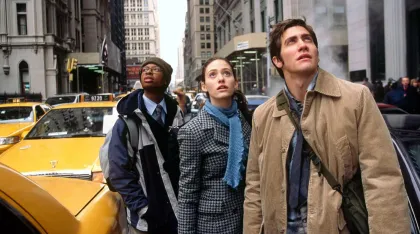
The Day After Tomorrow: Spectacle, Panic, and a Very Cold Warning
There are disaster movies that feel like carefully built machines, and then there are disaster movies that feel like an dare. The Day After Tomorrow belongs emphatically to the second category. Watching it years after its release, I’m struck less by its scientific credibility than by its confidence. Roland Emmerich has never been shy about scale, and here he takes a wildly implausible climate apocalypse and plays it with such sincerity that the film almost persuades you to ignore the physics and simply surrender to the spectacle. Almost.
What makes the film linger is its peculiar split personality. On one side, it is a popcorn catastrophe epic designed to deliver the sort of images that make a multiplex audience sit straighter in their seats. On the other, it wants to be a father-son survival story with a pulse of emotional repair running through it. Those ambitions do not always harmonize, but they do keep the movie from becoming a pure effects reel. At its best, The Day After Tomorrow is a paradox: overwrought and efficient, absurd and strangely affecting, blunt in dialogue but elegant in the way it stages destruction.
A disaster movie with a good memory for spectacle
The film’s greatest asset is its visual imagination. Emmerich understands that disaster cinema lives or dies on the audience’s ability to believe, for a few moments, that the impossible is happening right in front of them. The tidal wave sequence in New York remains the movie’s signature set piece, and it earns its place not merely through scale but through composition. The shot design is clear and terrifying. You understand where the water is coming from, what it is swallowing, and why the characters are trapped in the path of it. That clarity matters. Many modern effects-heavy films pile image upon image until the mind goes numb; here, the destruction is legible, almost readable.
Equally memorable is the movie’s use of cold. Not just as weather, but as texture. The white-out conditions, the frozen streets, the instant transformation of familiar city spaces into alien terrain all give the story a specific visual language. Emmerich loves big chaos, but he also knows that disaster becomes more frightening when it invades the ordinary. A library becomes a refuge. A hallway becomes a wind tunnel. A helicopter becomes a doomed attempt at escape against a sky too hostile to forgive anyone.
Emotions that arrive a little late, but still arrive
The central relationship between Jack Hall, played by Dennis Quaid, and his son Sam, played by Jake Gyllenhaal, gives the film its human spine. The script is not subtle about this. In fact, it practically places a sign over every emotional beat. But the performances keep the material from feeling entirely mechanical. Quaid brings a grounded steadiness to a role that could easily have become a slate of heroic scientist clichés. He gives Jack a thoughtful weariness, a sense of a man who has spent too much of his life being right too late. Gyllenhaal, meanwhile, lends Sam the right mixture of intelligence and adolescent stubbornness. He is credible as a teenager managing panic with improvised confidence.
What works in this thread is not nuance so much as momentum. The father’s journey toward the son, and the son’s own improvisational struggle in New York, create parallel lines that allow the movie to alternate between scale and intimacy. The emotional payoff is undeniably predictable, but predictability is not automatically a failure in a disaster film. Sometimes audiences do not want surprise; they want assurance that the people they have followed through impossible weather are still worth following when the storm clears.
The movie’s science is shaky, but its symbolism is clear
It is impossible to discuss The Day After Tomorrow without acknowledging that it asks for a suspension of disbelief that is, frankly, mountainous. The movie compresses and exaggerates climate phenomena with reckless enthusiasm. As science, it is dubious from the opening act onward. As allegory, though, it is remarkably straightforward. This is a film about what happens when human beings act as if warning signs are optional. It paints the planet as a system with a retaliatory streak, and whether or not one finds that idea intellectually satisfying, it undeniably gives the film urgency.
The real-world climate anxiety that the film taps into has only made it seem more culturally legible over time. It is not a sober environmental drama, and it never pretends to be. Yet beneath the thunderous delivery style, there’s an unmistakable push toward collective responsibility. The movie’s most melodramatic lines are also the ones that best summarize its thesis: the earth does not need us to survive; we need a survivable earth. The film says that with all the elegance of a warning siren, but the point lands.
Supporting players, brief appearances, and the pleasure of recognizability
One of the pleasures of revisiting a movie like this is recognizing how efficiently it deploys strong supporting actors. Ian Holm brings warmth and dignity to the role of a scientist with a humane core. Sela Ward gives the White House material enough seriousness to stop it from becoming pure bureaucratic filler. There are also the customary disaster-movie walk-ons: the people who appear, contribute a function, and disappear under the film’s larger machinery. Emmerich treats these roles as pressure valves, giving the story enough social texture to suggest a larger world beyond the surviving main characters.
The film’s ensemble is not deep in the psychological sense, but it is well distributed. Each figure exists to keep the survival terrain visually and emotionally varied. That matters because the movie is not interested in one enclosed crisis. It wants to move across geography, class, and institution: libraries, hospitals, research facilities, city streets, border spaces, and government rooms. The result is a global emergency felt through a string of localized disasters. That structural choice gives the film a lot of propulsion, even when the dialogue is doing its best to flatten the air around it.
Where the film stumbles, it stumbles loudly
The Day After Tomorrow is not a subtle movie, and at times it mistakes volume for conviction. Some exchanges are so on-the-nose they feel like they were written while a warning light was flashing in the room. Certain character movements are dictated less by logic than by the demands of the next visual crisis. The film also has a habit of turning real peril into a sequence of conveniently timed near-misses. That can be fun, but it can also become repetitive. After a while, the audience starts to sense the pattern: a threat builds, a character runs, the environment becomes more hostile, and the movie cuts away to another pocket of panic.
Still, I would rather a disaster film overcommit than drift. Emmerich’s direction is far too blunt to be elegant in the usual sense, but his certainty gives the movie force. There is little hesitation in how it moves from one calamity to the next. The pacing may occasionally feel like it is sprinting in place, yet the film is rarely dull. Even its excesses are watchable because they are delivered with such unapologetic enthusiasm.
A generous, big-budget warning sign
Seen now, The Day After Tomorrow sits in that amusingly durable space occupied by early-2000s spectacle cinema: too earnest to be irony, too ridiculous to be solemn, too committed to its own premise to become a joke. That is part of its charm. It is a movie that understands the ancient contract of disaster storytelling. Give the audience something enormous to look at, give them a few characters to follow through the wreckage, and give them enough emotional scaffolding to care whether the survivors make it through the frame.
Because of that, the film remains effective as entertainment even when its logic frays. It is a work of maximalist disruption, and its pleasures are immediate rather than refined. You do not admire The Day After Tomorrow for restraint. You admire it, if you do, for the audacity of its bad weather, for the seriousness with which it embraces nonsense, and for the way it turns apocalypse into a strangely brisk, almost old-fashioned studio adventure.
As a reviewer, I’d say its legacy rests on two things: unforgettable imagery and complete commitment. It is not the smartest disaster movie, or the most emotionally layered, but it is one of the most consistently legible. You always know what the film wants you to feel. That can be a flaw in drama, but in a movie about collapsing ice, collapsing cities, and collapsing certainty, it is also a kind of brutal clarity.
How to watch The Day After Tomorrow online
Availability & Access: The Day After Tomorrow is often available to stream or rent on major platforms depending on your region. It is not usually free on premium services, though library-style access can change. If you want to watch or stream it online, check current listings for subscription availability or rental pricing; sometimes it can also be found for download through approved stores for offline viewing.
Age Rating (US-based): PG-13. The film contains intense disaster sequences, frightening imagery, and some language, so parental guidance is recommended for younger viewers.
Netflix: Availability changes by country. If it is included in your region, it can typically be watched within the subscription and may allow offline download on supported devices.
Amazon Prime Video: Usually offered to rent or buy, and in some regions may be included with a subscription for limited periods. Offline access is available through the app for eligible purchases or streams.
Apple TV: Commonly available for purchase or rent in high quality, with download support through the Apple TV app for offline viewing.
Peacock: Availability varies. If included on the service, it may be part of a premium catalog rather than a free tier, with download access limited to supported plans and devices.
Hulu: May appear depending on licensing. When available, it is generally tied to subscription access, and download options are restricted to app-supported plans.
YouTube (Movies): Usually available as a rent or buy title. Downloads are possible through the YouTube app for offline playback where supported.
Pros:
- Strong visual spectacle with memorable disaster sequences, especially the New York flooding scene
- Clear, easy-to-follow action that keeps the pace engaging throughout
- Dennis Quaid and Jake Gyllenhaal give grounded performances that help anchor the story
- Effective use of cold, snow, and city destruction to create a distinctive atmosphere
- A straightforward emotional core centered on family survival gives the film some heart
- The movie’s scale and commitment make it highly entertaining as a blockbuster disaster film
Cons:
- The science is highly questionable and often strains credibility
- Some dialogue is blunt and overly on-the-nose
- Character decisions sometimes exist mainly to move the plot into the next disaster set piece
RELATED MOVIES


Movie Reviews

Fortnite

Minecraft

Grand Theft Auto V

Toca Boca World