
Review
Toca Kitchen was, for years, the single app most people meant when they said "the Toca Boca cooking game," and it's the title that buil...

Culinary Adventures and Creative Play: Exploring Toca Boca Jr Kitchen
Toca Kitchen was, for years, the single app most people meant when they said "the Toca Boca cooking game," and it's the title that built the studio's early reputation before its Toca Life franchise took over as the company's flagship product. It's also, as of a few years ago, not something you can actually download on its own anymore. Anyone searching for it today runs into a bundled subscription app instead of the standalone icon they remember, and that shift says as much about how kids' app publishing has changed over the past decade as it does about the game itself.
The underlying cooking gameplay hasn't really been reinvented in that time, but everything around it — how it's packaged, priced, and discovered — has shifted enough that the version of "Toca Kitchen" a parent remembers from a decade ago and the one their own kid encounters today are two genuinely different products wearing the same name.
From a Swedish Startup to a BAFTA Winner
Toca Boca was founded in Stockholm on July 18, 2010, by Emil Ovemar and Björn Jeffery, both formerly of the Bonnier Group, and the studio released its first app, Helicopter Taxi, in March 2011. Toca Kitchen followed soon after and quickly became the studio's breakout hit, going on to win a BAFTA Children's Award in 2013, a genuinely significant achievement for a small independent studio competing against much larger, better-funded children's media companies, and one that put the studio's design philosophy on record early: build around genuine, unstructured play rather than the more common gamified reward loops most children's software was already leaning toward by the early 2010s.
That early success helped Toca Boca's broader catalog cross one billion downloads across 238 markets, a scale that eventually attracted the attention of Spin Master, the Canadian toy and entertainment company that acquired Toca Boca and its sister studio Sago Sago in 2016 for roughly SEK 263 million. Fredrik Löving took over as CEO in 2020, and under Spin Master's ownership the studio shifted its broader strategy away from dozens of individual standalone apps toward consolidated platforms, a shift that eventually caught up with Toca Kitchen itself.
That broader industry pattern isn't unique to Toca Boca, either — plenty of once-standalone children's apps from the same early-2010s wave of educational app development have been folded into subscription bundles over the past several years, as publishers discovered that recurring subscription revenue was considerably more sustainable than one-time purchases in a marketplace increasingly dominated by free-to-download, ad-supported alternatives.
What Actually Happens When You Play
The core design hasn't changed much from what made the original version popular, which is itself part of the appeal:
- Players pick one of four characters — a boy, a girl, a cat, or a bull — each with distinct food preferences and reactions
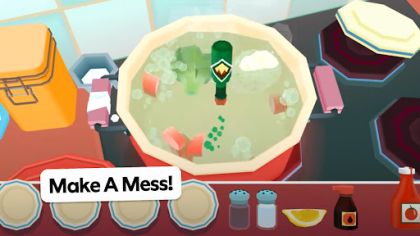
- Twelve different food items can be prepared using real cooking actions like chopping, blending, sautéing, boiling, and microwaving
- There are no win or lose conditions, no scoring system, and no required sequence of steps
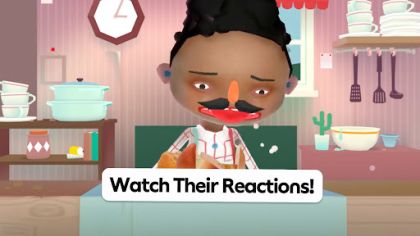
- Characters visibly react to what they're fed, sometimes enthusiastically eating a creation and sometimes rejecting it outright
- Food changes appearance in real time during preparation, including visible browning during cooking, giving kids direct visual feedback on their choices
That total absence of rules is the design decision reviewers consistently point to as the app's biggest strength. Common Sense Media specifically praised it as an "imaginative cooking game with no rules," noting that kids pick up meaningful lessons about food preparation and animal dietary differences simply by experimenting, without ever facing a fail state that would make a young child give up out of frustration.
The one recurring criticism is more about interface than concept: the tap-and-drag sequences needed to chop or blend ingredients can be genuinely tricky for very young players to execute cleanly at first, even though most kids adjust within a few sessions. Parents reviewing the app have also pointed out something less obvious but genuinely valuable: because the characters have distinct, consistent food preferences rather than accepting anything a player hands them, kids start picking up on cause and effect almost immediately, learning through repeated trial that a cat character reacts very differently to a plate of vegetables than the human characters do, without the game ever needing to explain that difference in words.
Where Toca Kitchen Actually Lives Now
Here's the part that surprises a lot of returning players: the standalone Toca Kitchen app most people remember was pulled from Google Play, after racking up roughly 43 million downloads and a 3.62-star rating across around 210,000 reviews during its run. It wasn't shut down outright, though — the game was folded into Toca Boca Jr, a subscription-based bundle app that consolidates Kitchen 2 alongside a rotating lineup of other Toca Boca titles:
- Toca Boca Dance
- Pet Doctor
- Parties, added in a recent update
- Nature
- Cars
- Lab: Elements
- Builders
How It's Actually Rated Today
Age and quality ratings have stayed remarkably consistent even as the packaging around the game changed entirely:
- Common Sense Media rates it appropriate for ages 4 and up, in line with the original standalone release
- Parents consistently cite the pressure-free, exploratory structure as the single biggest selling point over competing cooking apps
- The bundled Toca Boca Jr app markets itself specifically around being ad-free, a differentiator from many competing children's apps that rely on ad revenue
- Reviewers have flagged one minor, ongoing critique that's persisted across multiple versions of the app over the years: characters simply drop food they dislike rather than modeling any kind of polite rejection, a small missed opportunity for the kind of social-skills modeling other kids' apps build in deliberately, and one that's gone unaddressed even through the transition from standalone app to bundled platform title
None of that critique has meaningfully dented the game's reputation among parents and educators, who continue to treat it as a reliable entry point for open-ended creative play rather than judging it against more structured, achievement-driven kids' apps. It's a useful reminder that review scores for children's software often measure something different than they do for other app categories entirely — parents and educators tend to weigh predictability, safety, and developmental value far more heavily than novelty or technical polish, which is part of why a decade-old cooking mechanic can still earn consistently strong recommendations even as flashier, more feature-dense competitors have launched and faded around it.
Summary
Toca Kitchen built its reputation on a genuinely rules-free cooking simulation that won a BAFTA Children's Award back in 2013 and helped establish Toca Boca as a major name in children's app development before Spin Master's 2016 acquisition. The standalone app quietly disappeared from app stores in April 2024, not through cancellation but through consolidation into Toca Boca Jr, a subscription bundle that keeps Kitchen 2 free for past purchasers while introducing new players to it as one part of a much larger, ad-free platform.
Pros:
- User-friendly interface with intuitive controls
- Vibrant visuals and pleasing sound effects
- Cross-platform performance ensuring a consistent experience
- Educational elements integrated into culinary tasks
- Free access with opportunities for APK installation in restricted networks
- Engaging and imaginative gameplay that encourages creativity
Cons:
- Occasional minor bugs that may affect gameplay
- Lack of competitive challenges for users seeking a high-stakes experience
- Limited support on Windows and Mac systems
RELATED APPS

Recent Reviews

Fortnite

Minecraft

Grand Theft Auto V

Toca Boca World