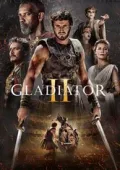
Review
Gladiator 2 arrives with the burden that only a sequel to a modern epic can carry: it must justify itself not merely as a continuation,...
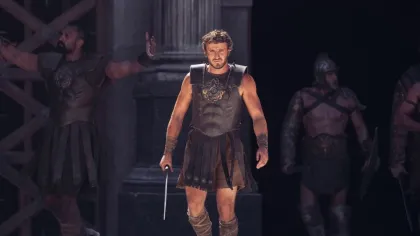

Gladiator 2 Review: Rome’s Spectacle, Power, and Decay Reimagined
Gladiator 2 arrives with the burden that only a sequel to a modern epic can carry: it must justify itself not merely as a continuation, but as a reason to return to a cinematic world that once felt complete. Ridley Scott, ever the grand historian of spectacle, does not approach the material timidly. He treats Rome as both myth and machine, a place where pageantry conceals rot, and where power always asks for blood, whether in the arena or the senate. The result is a film that often feels less like a sequel than a renewed argument with history, ambition, and the mythology of masculine glory.
What most immediately separates Gladiator 2 from its predecessor is its mood. The first film moved with the tragic certainty of a classical poem. This new chapter is more fractured, more political, and in some ways more openly cynical. The empire here is not just decadent; it is tired, self-aware, and desperate to keep pretending that tradition still means something. That gives the film a different emotional weight. Instead of asking whether honor can survive corruption, it asks what remains when every institution has already hollowed itself out. That shift is smart, even when the film occasionally gets tangled in its own scale.
Paul Mescal carries the center of the movie with admirable restraint. He is not trying to imitate Russell Crowe, nor should he. His presence is leaner, more inward, less thunderous. He plays a man shaped by loss but not defined by performance, and that distinction matters in a story so full of rituals and public displays. Mescal brings a watchful intensity that allows the quieter scenes to breathe. He can stand still in a room full of political vultures and make the silence feel like a threat. That is the kind of control the role requires, because this film is too large and too loud for a protagonist who needs to announce himself every minute.
Across from him, the supporting cast gives the movie much of its bite. Denzel Washington, in particular, is a force of nature, balancing charm, menace, and calculation with a fluency that reminds you why he remains one of cinema’s great presences. He understands that in a story like this, speech itself is an instrument of control. Every line lands either like an enticement or a warning. Pedro Pascal, meanwhile, brings a weary nobility to a role that could easily have been flattened into standard nobility-versus-corruption territory. He gives the movie a moral intelligence that helps anchor its more operatic impulses. Even when the screenplay strains under the weight of its own plotting, the actors keep the material alive.
Scott’s direction is, as expected, visually commanding. He still knows how to make architecture speak. The courtyards, corridors, arenas, and marble chambers are filmed not just as settings but as expressions of a civilization convinced of its permanence. That confidence is precisely what the movie keeps exposing as delusion. The production design does not merely recreate Rome; it makes Rome feel like a living contradiction, glorious and decaying at the same time. The textures matter. Dust hangs in the air. Sunlight looks brutal. Even the most elevated spaces feel ironed flat by habit and power.
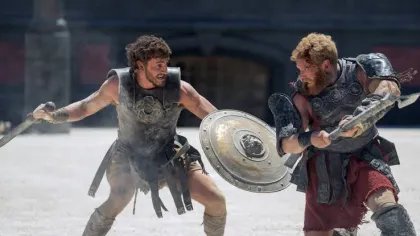
The action sequences are where Gladiator 2 most clearly announces its ambition, and also where the film reveals some inconsistency. When it is working, the combat is visceral in a way that feels earned rather than gratuitous. Scott understands the choreography of spectacle: the pause before impact, the way a crowd can transform violence into theater. Yet not every sequence lands with equal force. At times the film leans too heavily on digital enhancement, and the tactile immediacy that made the arena scenes in the original so unforgettable is occasionally diluted. The large-scale set pieces are impressive, but a few feel designed more to astonish than to wound. The difference matters. Great action should not only be seen; it should leave a scar in memory.
The script navigates a difficult balance between inherited mythology and new dramatic territory. There are echoes throughout, some elegant and some more obvious than they need to be. The film wants the audience to feel the shadow of the first Gladiator without merely repeating its emotional mechanics. That is a delicate challenge, and the screenplay only partially solves it. Certain character arcs unfold with genuine momentum, while others seem to exist mainly to move the plot to its next grand gesture. Still, the themes are coherent enough: legacy, performance, institutional decay, and the cost of turning human life into civic entertainment.
One of the film’s most interesting qualities is its awareness of spectacle as manipulation. Gladiator 2 is not interested in pretending the arena is noble. It knows the coliseum is a machine for converting suffering into consensus. The crowds crave not justice but distraction, not truth but ceremony. That makes the film feel surprisingly contemporary without becoming clumsy about it. The parallels are there, but Scott does not underline them with a heavy hand. He trusts the audience to understand that empires do not vanish because they become evil; they vanish because they become bored, corrupt, and unable to believe in themselves.
There are moments when the movie reaches for grandeur and catches something close to it. A speech can land with startling force. A confrontation can suddenly gather tragic inevitability. A line of succession can feel like a verdict against an entire mode of civilization. At those moments, Gladiator 2 becomes the kind of old-school epic that feels almost endangered by modern cinema’s impatience. It is willing to be solemn. It is willing to be elaborate. It is willing to believe that crowds, crowns, and collapsing institutions still matter as dramatic material. That seriousness is refreshing, even when the film does not fully escape the familiarity of its own genre rhythms.
What keeps the movie from becoming merely respectful imitation is the tension in its performances and the texture of its world. I found myself less interested in whether the film surpassed its predecessor than in how it reframed the emotional landscape of the original. Instead of the clean martyrdom of the earlier story, this one is preoccupied with inheritance, contamination, and the way systems reproduce themselves through both blood and spectacle. It is a messier vision, perhaps, but also a more politically alert one. Even when it falters, it rarely feels lazy.
If there is a weakness that lingers after the credits, it is that Gladiator 2 occasionally seems unsure whether it wants to be an intimate character drama disguised as a blockbuster or a full-scale imperial nightmare. The two modes do not always merge smoothly. Some scenes want stillness and interiority; others demand thunder. The film is strongest when it lets those modes collide rather than compete. When it trusts silence, faces, and the weight of history, it becomes absorbing. When it leans too hard on scale, it risks becoming just another expensive display of competence.
Even so, this is a substantial film, one that earns its place through force of craft more than novelty. It may not achieve the inevitability of the original, but it does not merely imitate it either. Instead, it returns to a familiar arena and asks what a later age can still say about honor, power, and public mythmaking. The answer is not always elegant, but it is often compelling. For viewers willing to meet it on its own terms, Gladiator 2 offers a robust, frequently thrilling, and occasionally mournful expansion of a world that still has enough life left in it to matter.
How to watch Gladiator 2 online
Gladiator 2 is expected to be available to watch on major platforms after its theatrical window, with access varying by region and release schedule. Free viewing is unlikely at launch, though subscription services may eventually carry it as part of their libraries. If you want to stream it, keep an eye on the usual platforms and official announcements for timing and availability.
In the US, the age rating for Gladiator 2 is expected to be R, due to intense violence, language, and mature thematic material. On Netflix, availability will depend on later licensing; if it arrives, download options typically work through the mobile app for offline viewing. Amazon Prime Video may offer the film to rent or purchase, with offline access available through the app for eligible titles. Apple TV usually provides high-quality rent or buy options, plus download availability after purchase. Peacock may carry it later on premium tiers rather than free access, with downloads limited to supported plans and devices. Hulu availability is less certain, and if offered, download features are usually restricted to ad-free plans and supported mobile devices. YouTube Movies generally provides rent or buy access, and downloads are available through the YouTube app for offline viewing on compatible devices.
Pros:
- Ridley Scott delivers a visually commanding and atmospheric return to ancient Rome.
- Paul Mescal brings a restrained and compelling presence to the lead role.
- Denzel Washington adds charisma, menace, and sharp intelligence in every scene.
- The production design makes the world feel both majestic and decayed.
- The film explores themes of legacy, power, spectacle, and institutional corruption with real ambition.
- Several action sequences are visceral and memorable, especially when the choreography leans into practical intensity.
- The supporting cast helps keep the film engaging even when the plot becomes complicated.
- The movie feels serious and purposeful rather than disposable or formulaic.
Cons:
- The film sometimes feels inconsistent in tone, shifting between intimate drama and large-scale spectacle.
- Some action scenes rely too heavily on digital effects, reducing their physical impact.
- The screenplay occasionally feels overstuffed and uneven in its character development.
- A few plot beats echo the original too closely, which can make the sequel feel familiar at times.






Movie Reviews

Fortnite

Minecraft

Grand Theft Auto V

Toca Boca World